Why Ingredient Traceability Is Becoming a Deal-Breaker for Beauty Buyers.
August 07, 2026
Why Ingredient Traceability Is Becoming a Deal-Breaker for Beauty Buyers.
"Where does this ingredient actually come from?" — this question is coming up more often in buyer conversations, and for good reason. 🔍🌿
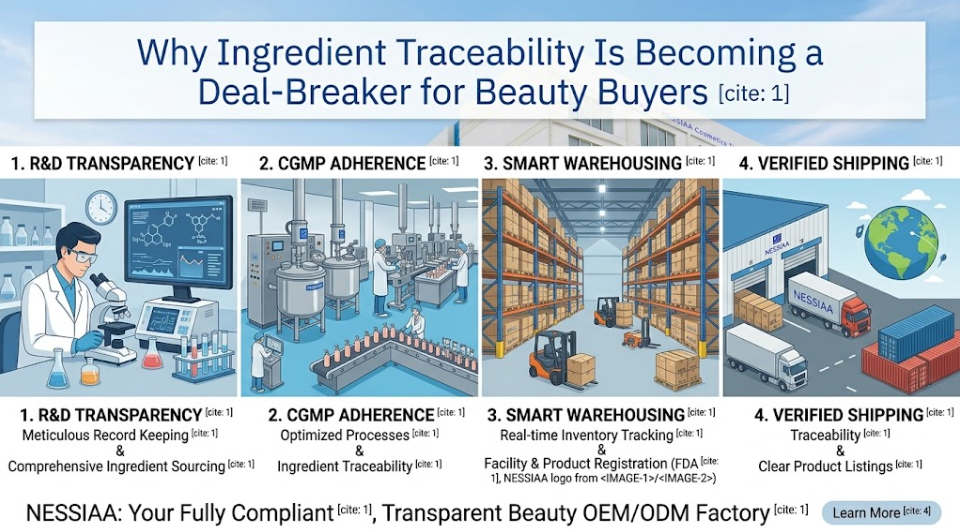
Why traceability matters now more than ever:
Consumers are increasingly skeptical of vague claims like "natural" or "clean" without evidence behind them. Retailers and distributors — especially in the US and EU — are starting to require documentation, not just marketing copy.
What ingredient traceability actually involves:
🔹 Supplier documentation — Knowing (and being able to prove) where raw materials are sourced from.
🔹 Certificates of Analysis (CoA) — Verifying purity, concentration, and safety for each ingredient batch.
🔹 INCI accuracy — Ensuring ingredient lists match what's actually formulated — a common gap when formulas are adjusted without updating documentation.
🔹 Consistency across batches — Ingredient sourcing should be consistent to avoid formula drift over time.
Why this matters for your brand's credibility:
Buyers, retailers, and increasingly consumers themselves are asking for this documentation before committing to a product line — particularly for claims like "vegan," "cruelty-free," or "clean beauty." A manufacturer who can't provide this documentation puts your brand's claims (and reputation) at risk.
A question worth asking early:
Before starting production, ask your manufacturer: "Can you provide ingredient traceability documentation for this formula?" If the answer is unclear, it's worth clarifying before scaling up.
🌐 www.nessiaa.com